Copper Mining: Global Trends, Environmental Impacts, and Future Technologies
You rely on copper every day — in your phone, home wiring, and the clean-energy technologies shaping tomorrow — and copper mining supplies that essential metal. Understanding where copper comes from, how it’s extracted, and the trade-offs between production and environmental impact helps you judge the industry’s role in modern life.
This article copper mining walks you through how copper mining works, from open-pit and underground operations to processing methods like crushing, grinding, and flotation, and it examines sustainability challenges and solutions shaping the sector today. You’ll get clear explanations of key processes, the major players and projects that matter, and practical context for why copper supply affects everything from infrastructure to the energy transition.
Overview of Copper Mining
Copper extraction combines large-scale earthmoving, concentrated processing, and refined metallurgical work to supply wiring, renewable energy, and electronics. You will learn where production is concentrated, which ore types dominate operations, and how mining methods match ore geometry and depth.
Global Copper Mining Industry
You rely on a global market that produced around 21 million tonnes annually in recent years, with Chile as the single largest producer supplying roughly a quarter of mined copper. Global production divides into concentrates, cathodes, and refined shapes used by electrical and construction sectors.
Price and demand drivers include electrification, grid expansion, and electric vehicle rollout. Investment flows favor large, long-life porphyry projects and near-term projects that can ramp quickly. Environmental regulation, permitting lead times, and capital intensity shape which projects reach production.
Major firms operate integrated mines, concentrators, and smelters to capture value across the chain. You should expect supply risks from geopolitical shifts, labor actions, and water or energy constraints, especially in arid mining regions.
Major Copper Mining Regions
South America dominates, with Chile and Peru together providing a substantial share of global mined output. Chile alone accounts for about 23% of global mined copper, driven by large open-pit porphyry mines like Escondida and Chuquicamata.
North America contributes via mines in the U.S., Canada, and Mexico; Canada produced over 500,000 tonnes in 2024, with British Columbia as a major source. Africa hosts significant deposits in Zambia and the Democratic Republic of Congo, often in mixed cobalt-copper operations.
You will also find important deposits in Australia and Russia. Regional differences matter: South American operations often face high elevation and water scarcity, while African and Russian projects may contend with infrastructure and governance challenges that affect costs and timelines.
Types of Copper Ores
Most primary copper comes from sulfide ores, especially chalcopyrite (CuFeS2), which require crushing, grinding, and flotation to produce concentrates. Sulfide processing often proceeds to smelting and electrolytic refining for high-purity cathode production.
Oxide ores, such as malachite and cuprite, are amenable to hydrometallurgical methods like heap leaching and solvent extraction-electrowinning (SX-EW). These methods lower capital intensity and allow recovery where smelting is uneconomic.
Mixed or secondary ores and supergene-enriched zones can contain copper in both sulfide and oxide forms, requiring hybrid processing circuits. You should assess ore mineralogy early; it determines plant design, operating costs, and environmental footprint.
Copper Mining Processes and Sustainability
You will find technical steps for turning ore into refined copper, the main environmental risks, industry measures to reduce harm, and emerging technologies reshaping the sector. Focus stays on practical methods, mitigation tactics, corporate and research initiatives, and realistic near-term trends.
Extraction and Processing Methods
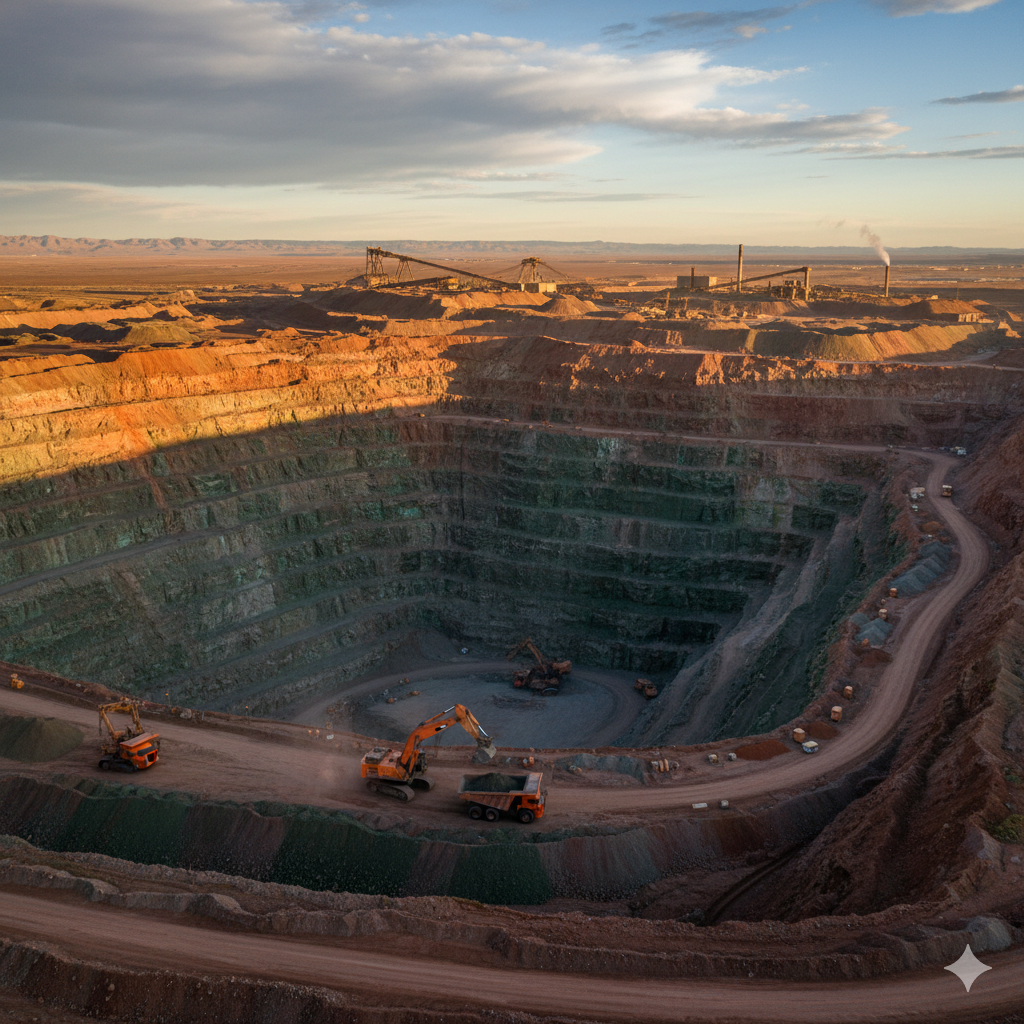
Open-pit and underground mining supply most copper ore. Open-pit suits near-surface, low-grade deposits and uses drilling, blasting, and large shovels; underground targets high-grade, deeper ore and uses block caving, cut-and-fill, or longhole stoping.
After extraction, comminution (crushing and grinding) reduces rock size to liberate copper minerals for separation.
You should expect two principal concentration routes: flotation for sulfide ores and leaching for oxide ores. Flotation creates a copper-rich concentrate for smelting. Heap leaching uses sulfuric acid for oxide and secondary sulfide ores, producing a copper-laden solution for solvent extraction and electrowinning (SX-EW), which yields cathode copper.
Smelting and refining remove impurities and produce blister copper; electrolytic refining produces high-purity cathodes.
Key process controls you should monitor: grind size, reagent dosing in flotation, heap permeability and irrigation rate in leaching, and energy use in smelting. These factors drive recovery, operating cost, and environmental footprint.
Environmental Impact and Mitigation
Mining affects land, water, air, and communities. Main impacts include habitat loss from pits and waste dumps, water contamination from acid rock drainage (ARD) and process effluents, and greenhouse gas emissions from energy-intensive crushing, smelting, and transport.
Airborne particulates and SO2 can arise from smelters and crushers without control systems.
You should expect standard mitigation measures: engineered tailings storage facilities with liners and seepage collection, water treatment (neutralization, filtration, constructed wetlands), and progressive land rehabilitation.
For ARD, strategies include sulfide isolation, covers to limit oxygen and water ingress, and in situ or ex situ biological/chemical neutralization. Emissions control includes scrubbers for SO2, baghouses for particulates, and switching to lower-carbon fuel and electricity sources.
Sustainable Mining Initiatives
You can evaluate sustainability across water use, energy, waste, and social governance. Companies increasingly deploy renewable power (solar, wind, hydropower) for milling and smelting to lower Scope 1 and 2 emissions.
Water-reduction tactics include dry stacking of tailings, paste backfill, closed-loop process water systems, and high-recovery filtration to cut fresh-water withdrawal.
Recycling and circular-economy approaches increase secondary copper from electronic scrap and urban mining, reducing primary extraction demand.
Community engagement practices you should look for include benefit-sharing agreements, local hiring and procurement, and transparent grievance mechanisms. Certification and reporting frameworks (e.g., ESG disclosures, third-party audits) help you verify corporate claims.
Future Trends in Copper Mining
You will see technology and policy drive near-term change rather than sudden transformation. Electrification of mobile fleets and increased site electrification reduce diesel use and on-site emissions.
Digital tools—autonomous trucks, predictive maintenance, and process optimization using AI—improve throughput and lower energy intensity.
Hydrometallurgical innovations, such as in situ leaching for amenable deposits and low-temperature bacterial bioleaching, could reduce surface disturbance and smelting needs for some ore types.
Urban mining, improved recycling yields, and design-for-recyclability in electronics will gradually shift supply mixes. Expect stronger regulatory pressure on water use and tailings standards, prompting more investment in dry tailings, monitoring technologies, and transparent reporting.