



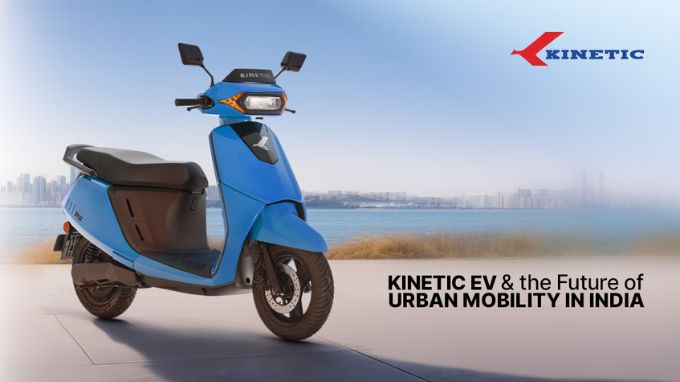
Kinetic EV & the Future of Urban Mobility in India
Urban mobility isn’t broken. But it is under pressure.
Step out during peak hours in any Indian city and you’ll see the same pattern; movement, density, urgency. Two-wheelers cutting through traffic. Short trips stitched into long days. Mobility here isn’t optional; it’s constant. But the system is under strain. Fuel prices fluctuate unpredictably. Congestion keeps getting worse. And for most people, commuting is becoming less about convenience and more about managing cost and time. That’s the context in which electric two-wheelers are gaining relevance. Not as a trend, but as a response.
Why EV two-wheelers are not a “nice-to-have” in India
India is not a car-first market. It never has been. Two-wheelers dominate because they make sense; economically, spatially, practically. And that’s exactly why electrification is finding its strongest footing here. From a technical standpoint, the use case aligns well:
- Daily commute distances typically fall within practical EV range bands
- Stop-and-go traffic actually benefits regenerative braking systems
- Lower drivetrain complexity reduces maintenance cycles
On paper, it fits. But adoption doesn’t happen on paper.
For Booking Click Here:- https://kineticev.in/book-now
The real shift: from fuel cost to total cost of ownership
For years, fuel price volatility has been a constant pressure point. EVs change that equation, but not just because electricity is cheaper than petrol. The real shift is toward Total Cost of Ownership (TCO).
When you factor in:
- No engine oil changes
- Fewer wear-and-tear components
- Lower per-km running cost
- Battery warranty structures
the economics start making sense over time. But, and this is important, TCO only works in your favour if the system around the vehicle holds up. Because savings disappear quickly if downtime increases or service becomes inconsistent.
The product is not the scooter. It’s the system behind it.
This is where a lot of the EV conversation still feels incomplete. An electric two-wheeler is not just a machine. It’s an ecosystem.
You’re dealing with:
- Battery Management Systems (BMS) that regulate performance and safety
- Controller units and power electronics that require specialized diagnostics
- Firmware layers that evolve over time
- Charging behaviour and battery degradation cycles
And unlike ICE vehicles, not every local mechanic can step in when something goes wrong. Which means the ownership experience is only as strong as the ecosystem backing it.
Smart features are useful. But reliability is non-negotiable.
Yes, today’s EVs are more connected than ever. App-based tracking, ride analytics, navigation integration, OTA updates, it’s all there. But here’s the reality: most riders don’t wake up thinking about connectivity features. They care about whether the scooter starts. Whether the range is consistent. Whether service is accessible. Technology adds value. Reliability builds trust. And right now, trust is the bigger differentiator.
Visit Our Website:- https://www.kineticev.in/
Why OEM credibility is becoming central again
This is where the conversation is quietly shifting. For a while, EV adoption was driven by novelty and early innovation. Now, it’s being shaped by risk awareness.
Buyers are asking different questions:
- Is there a service network in my city?
- What happens if the battery underperforms?
- How long will this brand be around?
And that’s bringing established OEMs back into focus. Because beyond the product, they offer:
- Existing dealer and service infrastructure
- Proven supply chain reliability
- Experience in managing vehicle lifecycle support
In a category where the backend matters as much as the front-end, that becomes a real advantage.
The India factor: building for actual conditions
One of the more overlooked aspects of EV design is localization. Indian riding conditions are not uniform. Traffic density, road quality, climate variation, and usage patterns differ widely, even within the same city. A product optimized for global benchmarks doesn’t always translate well here. Which is why durability, thermal management, suspension tuning, and real-world range calibration matter more than headline specs. This is not just about engineering. It’s about context.
Where Kinetic EV fits into this shift
In many ways, the current EV transition is not just about new players entering the market, it’s also about familiar ones re-entering with a different lens. Kinetic EV sits at an interesting intersection. It doesn’t have to build trust from scratch. The brand already carries recall from decades of being part of everyday mobility in India. What changes now is the layer on top of that, electric architecture, connected systems, and a more ecosystem-driven approach.
Instead of treating EVs as standalone launches, the focus is shifting toward:
- Building service readiness alongside product rollout
- Strengthening warranty and support structures
- Designing for real Indian usage patterns, not ideal scenarios
It’s a more grounded way of approaching electrification.
The market is moving past hype
If there’s one clear takeaway from the current phase, it’s this: the EV conversation is becoming more practical. Less about “what’s possible.” More about “what works.” Buyers are no longer just comparing specifications. They’re evaluating consistency, serviceability, and long-term reliability. And that’s a good sign. Because it pushes the industry toward better execution, not just better storytelling.
The road ahead is not just electric. It’s accountable.
India’s EV growth story is still unfolding. Battery technology will improve. Charging infrastructure will expand. Costs will continue to evolve. But alongside all of that, one expectation will remain constant: dependability. Because in a market like India, mobility is not aspirational. It’s essential. And the brands that will lead this transition won’t just be the ones that innovate. They’ll be the ones that stay reliable, long after the sale is made.



I’ve been exploring electric scooters recently, and the Kinetic DX+ definitely stands out in terms of usability and design. This article explains it well.